
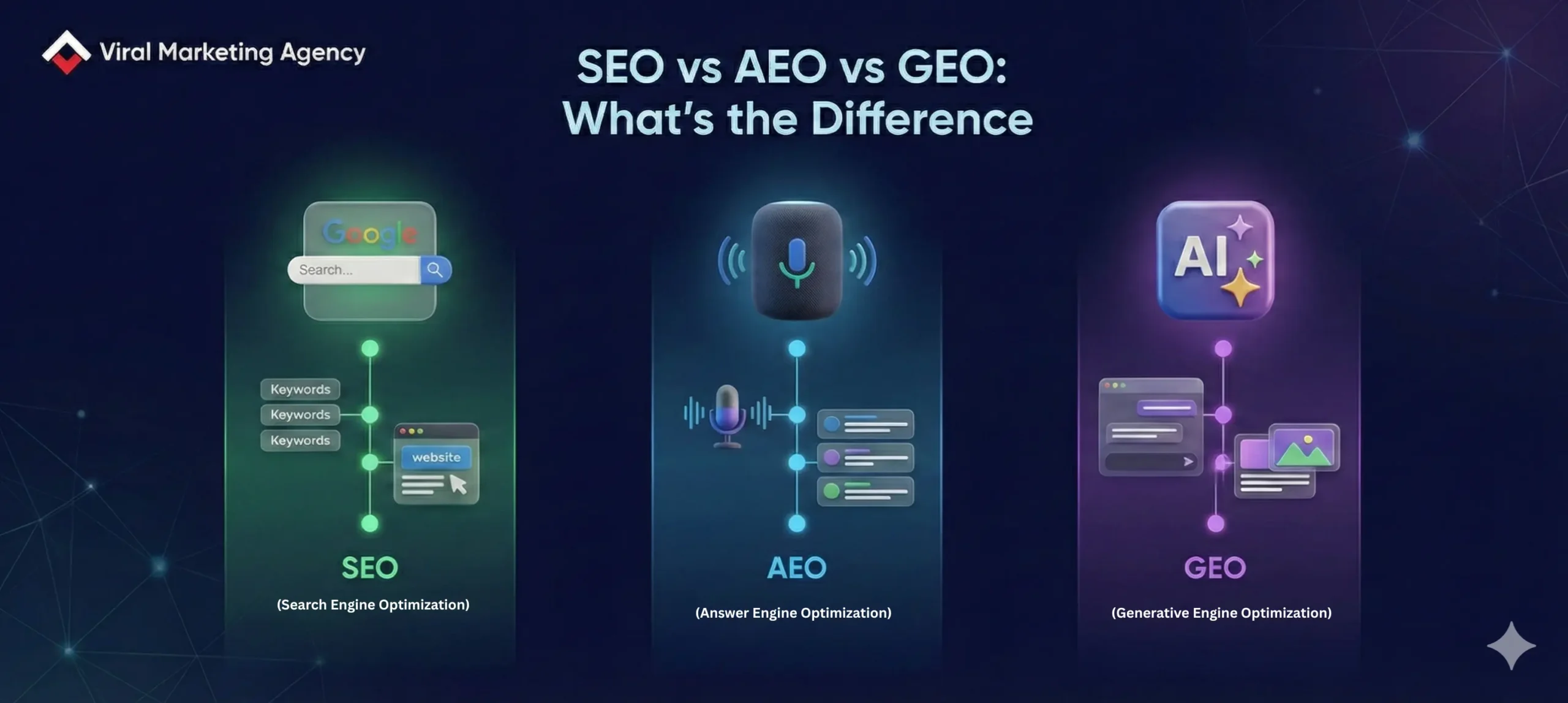
Introduction: Search Is Changing – And So Should Your Strategy
For years, businesses focused on one main goal: ranking on Google using SEO.
But today, search is no longer limited to traditional search engines. People now get answers from:
Google featured snippets
Voice assistants like Alexa and Siri
AI tools like ChatGPT, Gemini, and Copilot
Generative search experiences
This shift has introduced two new concepts alongside traditional SEO:
If you’re a business owner, marketer, or professional, understanding SEO vs AEO vs GEO is no longer optional. It’s essential for staying visible in a world where users expect instant answers, not just links.
This guide breaks down all three in simple language and shows how to use them together for modern search success.
What Is SEO? (Search Engine Optimization)
SEO (Search Engine Optimization) is the process of optimizing your website to rank higher on search engines like Google and Bing for relevant keywords.
The main goal of SEO is to:
Get more organic traffic by appearing in search results.
How SEO Works
SEO focuses on helping search engines understand and trust your website. It includes:
On-Page SEO
Keyword optimization
Title tags and meta descriptions
Headings (H1, H2, H3)
Content quality and relevance
Internal linking
Related: Expert on-page SEO techniques
Technical SEO
Website speed
Mobile friendliness
Indexing and crawlability
Site structure
HTTPS security
Related: The Importance of Technical SEO
Off-Page SEO
Backlinks
Brand mentions
Online authority
Trust signals
SEO Example
If someone searches:
“Best digital marketing agency in Jaipur”
SEO helps your website appear on page one so users click and visit your site.
SEO is still the foundation of online visibility, but it’s no longer the full picture.
What Is AEO? (Answer Engine Optimization)
AEO (Answer Engine Optimization) is the process of optimizing your content to provide direct answers to user questions, so platforms like Google, voice assistants, and featured snippets can show your content as the answer.
The main goal of AEO is to:
Become the direct answer, not just a ranked link.
Why AEO Exists
Users now search with natural, question-based queries like:
What is digital marketing?
How does SEO work?
Best time to post on Instagram?
Google and voice assistants try to answer these instantly.
AEO helps your content:
Appear in featured snippets
Show in People Also Ask boxes
Power voice search answers
Support zero-click searches
How AEO Works
AEO focuses on:
Clear, direct answers
Question-based content
FAQ sections
Structured data (schema)
Conversational language
AEO Example
Search:
“What is local SEO?”
Google may show a short paragraph from a website as the answer.
That website is optimized for AEO.
Even if users don’t click, your brand becomes the trusted source.
What Is GEO? (Generative Engine Optimization)
GEO (Generative Engine Optimization) is the process of optimizing your content so AI tools and generative search engines can understand, trust, and reference your brand when generating answers.
The main goal of GEO is to:
Become a trusted source for AI-generated responses.
This includes platforms like:
ChatGPT
Google SGE (Search Generative Experience)
Gemini
Microsoft Copilot
Perplexity AI
Why GEO Is Important
More people now ask AI tools questions instead of using Google directly.
These tools don’t just show links – they generate full answers using information from trusted sources.
If your brand is not optimized for GEO:
AI tools may ignore your content
Your competitors may be referenced instead
You lose visibility in AI-driven search
How GEO Works
GEO focuses on:
Topical authority
Clear expertise signals
Well-structured content
Entity recognition (brand + topic association)
High-quality, factual content
Strong online presence across platforms
GEO Example
User asks ChatGPT:
“Best ways to grow a local business online”
If your site is seen as a trusted authority, AI may use your insights to shape its answer even without linking directly.
That’s GEO in action.
SEO vs AEO vs GEO: Key Differences
Factor | SEO | AEO | GEO |
Focus | Rankings & traffic | Direct answers | AI-generated responses |
Platform | Google, Bing | Google, voice search | ChatGPT, Gemini, SGE |
Goal | Get clicks | Be the answer | Be the AI source |
Content Style | Keyword-focused | Question-based | Authority-based |
Visibility | Search results | Featured snippets | AI responses |
Why Businesses Must Care About All Three
Ignoring AEO and GEO means missing major visibility opportunities.
Key Impacts on Businesses
Less traffic from traditional searches
More zero-click results
More users using AI for research
More voice-based searches
More competition for trust and authority
If you only focus on SEO, you may rank but still lose visibility where users actually get answers.
Real-World Examples
Example 1: Traditional SEO
User searches:
“Best CRM software for small business”
SEO helps your blog rank and get clicks.
Example 2: AEO
User asks:
“What is CRM software?”
Google shows a featured snippet with a short definition.
AEO helps your site become that snippet.
Example 3: GEO
User asks ChatGPT:
“What tools should small businesses use to manage customers?”
GEO helps your brand or content be referenced or used in AI’s generated answer.
Three different behaviors. Three different optimization styles.
Actionable Strategies to Optimize for SEO, AEO & GEO Together
1. Build Strong SEO Foundations
You still need:
High-quality content
Keyword research
Technical SEO health
Backlinks
User-friendly design
SEO is the base for everything else.
2. Add Answer-Focused Content for AEO
Structure your content to answer real questions:
Use question-style H2 and H3 headings
Write short, clear definitions
Add FAQ sections
Use bullet points and steps
Write for voice search intent
Example:
What is AEO?
3. Build Authority for GEO
To improve GEO, focus on:
Publishing in-depth, expert content
Covering topics completely
Creating topic clusters
Strengthening brand mentions
Maintaining a consistent brand identity
Earning quality backlinks
Being referenced by other sites
AI tools trust brands that show:
Experience
Expertise
Authority
Trustworthiness (E-E-A-T)
4. Use Structured Data & Clear Formatting
Help both search engines and AI understand your content by using:
FAQ schema
HowTo schema
Clear headings
Clean site structure
This improves AEO and GEO performance.
5. Think Beyond Traffic
Modern visibility means:
Being seen in snippets
Being referenced in AI answers
Being trusted as a source
Being remembered as a brand
Traffic is important, but authority is becoming more valuable.
The Future of Search: Where SEO, AEO & GEO Are Headed
Search is moving from:
Links → Answers → Generated responses
In the coming years, expect:
More AI-generated results
Fewer traditional clicks
More conversational search
More entity-based ranking
More importance on brand trust
Businesses that adapt early will have a major advantage.
Final Thoughts: It’s Not SEO vs AEO vs GEO – It’s SEO + AEO + GEO
These are not competing strategies. They are connected layers.
Think of it like this:
SEO gets you discovered
AEO gets you chosen as the answer
GEO gets you recognized by AI
Modern search success means using all three together.
If your content is helpful, authoritative, and well-structured, you don’t just rank – you become part of how answers are created.
That’s the future of digital visibility.
Frequently Asked Questions (FAQ)
Is SEO still important in 2026?
Yes. SEO is still the foundation for visibility, indexing, and authority.
What is the biggest difference between SEO and AEO?
SEO focuses on rankings and traffic. AEO focuses on becoming the direct answer.
Do small businesses need GEO?
Yes. As more people use AI tools, GEO helps ensure your brand stays visible beyond Google.
Can one piece of content support SEO, AEO, and GEO?
Yes. Well-structured, authoritative content can support all three at the same time.