
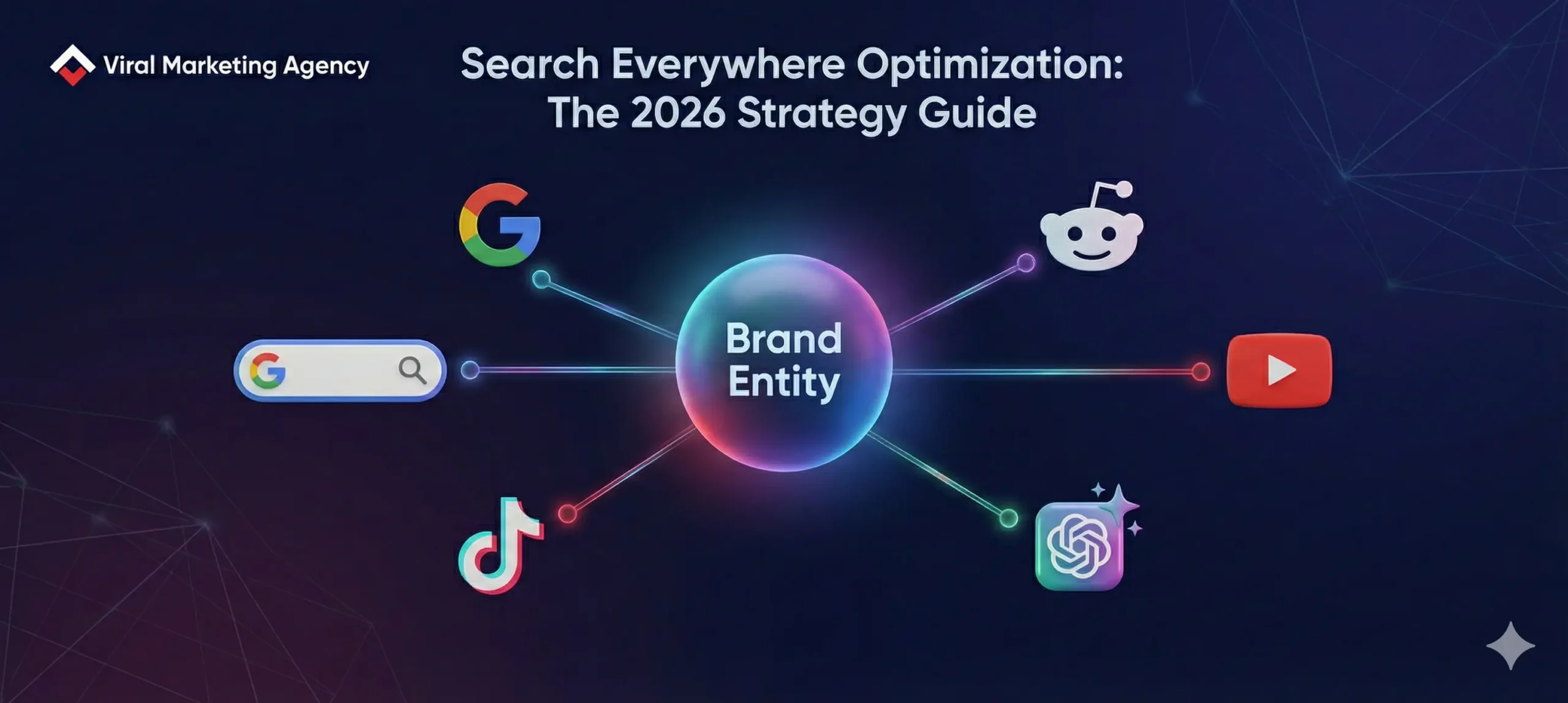
The digital marketing landscape has reached a critical inflection point. For nearly two decades, the term “search” was synonymous with Google. Marketing strategies were built on the predictable foundation of the “ten blue links,” where success was measured in organic rankings and click-through rates. However, as we move through 2025 and look toward 2026, that era is officially over. We have entered the age of Search Everywhere Optimization (SEvO), a paradigm shift where discovery happens across a fragmented ecosystem of social media platforms, community forums, e-commerce marketplaces, and generative artificial intelligence.
At Viral Marketing Agency, we have observed this transition firsthand. Business owners and professionals who once dominated the first page of Google are now finding that their traffic is plateauing or declining, even as their rankings remain stable. The reason is simple: the audience has moved. Users are no longer content to scroll through pages of links; they are searching for authentic, immediate, and visual answers on TikTok, Reddit, YouTube, and ChatGPT. To remain visible in this new reality, a business must become ubiquitous, ensuring that its brand is the answer wherever a question is asked.
The Evolution of Search: Why Traditional SEO Is No Longer Enough
The fundamental mechanism of discovery has changed because user behavior has decentralized. In the past, the search journey was a linear path starting at a search bar. Today, that journey is erratic and multi-platform. A customer might see a teaser for a product on Instagram Reels, search for authentic reviews on Reddit, watch a detailed demonstration on YouTube, and finally use an AI tool like Perplexity to compare prices before making a purchase.
This fragmentation is most visible in the data regarding younger demographics. Generation Z is leading the retreat from traditional search engines, with 46% of Gen Z users preferring social media over Google for discovery. For these users, search is a visual and social experience. They trust the “proof of life” found in a 15-second TikTok video more than a highly polished, SEO-optimized blog post.
| Metric | 2020 Baseline | 2025 Reality | Trend Direction |
|---|---|---|---|
| Google Search Market Share | ~92% | ~89.6% | Decreasing |
| Gen Z Social-First Search | ~25% | ~41% | Increasing |
| Zero-Click Search Rate | ~35% | ~57% | Increasing |
| AI Overview (AIO) Coverage | 0% | ~85% | Dominant |
Traditional SEO focused on optimizing a specific URL for a specific keyword. Search Everywhere Optimization, by contrast, focuses on managing a decentralized web of signals to influence an answer across the entire digital footprint. It is the difference between ranking a page and building a reputation that machines and humans can recognize everywhere.
Defining the Concept: SEO, GEO, and AEO
To understand Search Everywhere Optimization, we must break it down into its three constituent parts: Search Engine Optimization (SEO), Generative Engine Optimization (GEO), and Answer Engine Optimization (AEO). Together, these form a holistic approach that Viral Marketing Agency refers to as the “Ubiquity Framework”.
The Role of Traditional SEO (1.0)
Standard SEO remains the bedrock of digital visibility. It involves technical site health, mobile responsiveness, and keyword-driven content that traditional crawlers can index. However, in the SEvO era, traditional SEO acts as the “source of truth.” It is where your authoritative data lives, serving as the primary resource that AI models and social algorithms use to verify your brand’s existence and expertise.
The Rise of Generative Engine Optimization (GEO)
GEO is a newer discipline focused on shaping how AI systems like ChatGPT, Google Gemini, and Claude understand and cite your information. Unlike ranking on a page, GEO is about “Citation Frequency”, ensuring that when an AI summarizes a topic, it uses your brand as a primary source. This requires structured data, original research, and content that is “cheap for a machine to interpret”.
The Expansion of Answer Engine Optimization (AEO)
AEO focuses on providing the single, definitive answer to a user’s question, particularly through voice assistants and conversational AI. AEO strategies require content to be formatted in direct, conversational Q&A pairs. In a “zero-click” world, the goal of AEO isn’t just to get a click; it’s to have your brand’s answer spoken by a device or featured in an AI snippet, establishing instant authority.
The Impact: Navigating the Zero-Click Reality
The most significant impact of SEvO is the rise of the “Zero-Click Search.” This occurs when a user finds the answer they need directly on the search results page or within an AI interface, never clicking through to a website. For many businesses, this feels like a loss. However, at Viral Marketing Agency, we view it as an opportunity for “Brand-Driven Influence”.
When your brand is cited by an AI overview, you may lose a website visit, but you gain an authoritative endorsement from the search engine itself. Research indicates that users who see a brand cited in an AI overview are 2.3 times more likely to perform a branded search for that company later. Success in 2025 is measured by “Share of Voice” within AI responses rather than just the total number of clicks.
Traffic Volatility and Strategy Shifting
Since the full rollout of AI Overviews, roughly 44% of websites have seen flat or declining organic traffic. This has forced a massive reallocation of resources. Marketers are moving away from high-volume, generic keywords and toward high-intent, long-tail conversational queries that AI is more likely to synthesize.
| Search Type | Optimization Focus | Outcome Priority |
|---|---|---|
| Informational | AI overviews and FAQs | Citation and authority |
| Commercial | Reddit, YouTube, and review platforms | Trust and validation |
| Transactional | Amazon listings and local maps | Conversion and proximity |
| Navigational | Brand entities and Wikipedia | Accuracy and recognition |
Social Search: Winning the “Discovery” Phase
For many users, especially Gen Z and Millennials, the search journey no longer begins on Google; it begins on TikTok, Instagram, and YouTube. Social platforms have evolved from scrolling feeds into robust discovery engines.
TikTok as a Search Engine
TikTok’s search functionality is increasingly sophisticated. Users treat it as a “visual Wikipedia,” searching for everything from recipes to financial advice. TikTok search is driven by three core signals: captions, hashtags, and the audio itself. The platform’s transcription AI indexes the words spoken in a video, meaning that verbalizing your keywords is now as important as writing them.
To dominate TikTok search, brands must capture attention in the first 3 seconds with a “hook” that matches the user’s search intent. If someone searches for “best waterproof mascara,” they want to see a real person testing it in water immediately, not a 30-second introduction about the brand.
The YouTube Authority Factor
YouTube remains the second largest search engine in the world, processing billions of queries daily. In the SEvO landscape, YouTube serves as the platform for “in-depth validation”. After discovering a product on TikTok, users often go to YouTube for long-form reviews or tutorials. Optimizing for YouTube search requires detailed video descriptions, clear timestamps, and transcripts that help AI bots understand the content of the video for indexing in Google’s “Video” results.
Community Search: The Power of Reddit and Quora
In an era of AI-generated content and “AI slop,” users are craving human authenticity. This has led to a massive resurgence in the search value of community platforms like Reddit. Google has responded to this shift by prioritizing Reddit threads in its search results, particularly for queries that include the word “review” or “best”.
Reddit is a “Trust Engine.” When a user searches for a solution on Reddit, they are looking for the unfiltered opinions of peers. Brands cannot simply spam Reddit with links; they must participate in the community. Viral Marketing Agency encourages clients to build a presence in relevant subreddits by answering questions and sharing expertise without a “salesy” tone. These unlinked brand mentions are captured by AI training sets and contribute significantly to your brand’s “Entity Authority”.
The Technical Backbone of SEvO: Schema and Machine Readability
The hidden architecture of Search Everywhere Optimization lies in making your content “cheap for machines to interpret”. Large Language Models and search algorithms are under constant pressure to process billions of pages efficiently. The easier you make it for them to understand who you are and what you do, the more likely you are to be cited.
Essential Schema Markup for 2026
Schema markup is the machine-readable language of the internet. By 2025, it has evolved from a “nice-to-have” to a mandatory requirement for AI visibility.
| Schema Type | Purpose | Key Property |
|---|---|---|
| Organization | Identifies the brand entity | sameAs (links to social profiles / Wikipedia) |
| Product | Enables price and stock visibility in results | aggregateRating (social proof) |
| FAQPage | Feeds AI assistants and voice search answers | acceptedAnswer (direct response) |
| Article | Defines expertise, authority, and freshness | author (linked to expert bio) |
| LLMs.txt | Directs AI bots to priority content | Summary (clear markdown purpose) |
The Implementation of LLMs.txt
The llms.txt file is a new standard designed to help AI models like ChatGPT and Perplexity navigate your site. Located at the root of your domain (yoursite.com/llms.txt), this file provides a markdown-formatted summary of your site’s most authoritative content. It is essentially a “media kit” for robots, ensuring that when an AI crawler visits, it immediately understands your core services, your best research, and how to cite you accurately.
E-E-A-T: The Human Element in an AI World
Google’s emphasis on E-E-A-T (Experience, Expertise, Authoritativeness, and Trustworthiness) is the only defense against the flood of AI-generated filler content. In the Search Everywhere era, “Experience” is the most critical component. AI can summarize facts, but it cannot “experience” a product or a service.
Demonstrating Real-World Experience
To satisfy E-E-A-T requirements, content writers must move beyond “what” and into “how” and “why”. This means:
- Original Imagery: Use real photos of your team or products, not stock photography.
- Case Studies: Detail actual problems you solved for clients, providing data and specific outcomes.
- Author Credentials: Every blog post should have a clear byline linking to an author page that highlights the writer’s years of experience and professional affiliations.
Viral Marketing Agency emphasizes that trust is built through transparency. Citing credible sources and providing clear editorial standards signals to both users and AI models that your information is reliable.
Actionable Tips: Your 10-Step SEvO Checklist
Transitioning to a Search Everywhere strategy can be overwhelming. To help business owners and professionals, we have developed this step-by-step roadmap for implementation.
Step 1: Audit Your Managed Experiences
Review your “Managed Experiences”, the platforms you control, such as your website, official social profiles, and e-commerce listings. Ensure your branding, contact information, and core messaging are consistent across all channels. A fragmented identity confuses both customers and AI models.
Step 2: Map the Buyer’s Journey Across Platforms
Identify where your audience goes during the “Discover,” “Compare,” and “Act” phases. For example, if you sell home renovation services, your audience might “discover” you on Pinterest, “compare” you on Reddit, and “act” by visiting your Google Business Profile.
Step 3: Implement Identity Schema
Use JSON-LD to implement Organization schema on your homepage. Link all your social profiles using the sameAs property. This creates a “Knowledge Graph” that tells Google and AI tools that all these different profiles belong to the same trusted entity.
Step 4: Optimize for Conversational Keywords
Shift your keyword strategy toward natural language questions. Instead of targeting “SEO services,” target “How does an SEO agency improve my business in 2026?” This aligns with how people speak to voice assistants and interact with AI chatbots.
Step 5: Leverage Short-Form Video SEO
Create vertical videos for TikTok, Reels, and YouTube Shorts. Use descriptive captions rich with keywords, and ensure your verbal hook happens in the first three seconds. Remember to say your keywords out loud for transcription indexing.
Step 6: Claim Your Community Presence
Set up alerts for your brand name and industry keywords on Reddit and Quora. When relevant questions arise, provide helpful, detailed answers without pushing a sales agenda. Building up “goodwill” in these communities is a long-term play for AI authority.
Step 7: Create an LLMs.txt File
Follow the standard markdown structure to create an llms.txt file at your root directory. Include a clear summary of your business and links to your most important case studies, research papers, and product pages.
Step 8: Build Topical Authority with Clusters
Don’t just write isolated blog posts. Create “Topic Clusters” where one pillar page (e.g., “The Ultimate Guide to Digital Marketing”) links to dozens of specific, long-tail sub-pages (e.g., “How to Use TikTok for B2B”). This signals deep expertise to AI models.
Step 9: Encourage User-Generated Content (UGC)
Ask satisfied customers to leave reviews on Google, Yelp, and industry-specific forums. Positive UGC is the most powerful trust signal in the SEvO landscape. AI models prioritize brands that have a consistent stream of positive mentions from real people.
Step 10: Monitor AI Share of Voice
Use tools like Otterly.ai or SEMrush to track how often your brand appears in AI-generated responses. Don’t just look at traffic; look at whether the AI characterizes your brand as a leader in your industry.
Case Studies: Real-World SEvO Success
To demonstrate the power of Search Everywhere Optimization, let’s look at three organizations that have successfully navigated the transition from traditional SEO to a multi-platform strategy.
HubSpot: The Topic Cluster Model
HubSpot moved beyond individual keywords to own the “Inbound Marketing” conversation entirely. By creating comprehensive pillar pages and interconnected cluster content, they became the primary source for both Google rankings and AI-generated definitions of marketing terms. Their strategy ensures that no matter where a user asks a marketing question, a HubSpot resource is likely to be cited.
Canva: Long-Tail Keyword Domination
Canva targeted millions of highly specific, long-tail queries like “Instagram story templates” and “YouTube banner maker”. They didn’t just rank for “design software”; they ranked for every possible design use case. This granular approach ensures they appear in visual searches on Pinterest, transactional searches on Google, and “how-to” searches on YouTube.
Truly Beauty: The Discovery Loop
Truly Beauty utilized TikTok to drive initial discovery, creating viral videos that showcased their products in use. This social-first approach led to a massive increase in branded searches on Google as users moved to the “validation” phase. By maintaining consistent messaging on their website, Amazon, and social media, they created a seamless transition from discovery to action.
The Future of Search: What to Expect in 2026
As we look toward 2026, the trends that started in 2025 will accelerate. The most significant development will be the rise of “Agentic AI” – AI systems that don’t just answer questions but take actions on behalf of the user.
Agentic AI and Personal Discovery
In 2026, a user might tell their AI assistant, “Plan a weekend trip to Miami for a family of four, including a hotel with a pool and a gluten-free restaurant.” The AI agent will perform the search, comparison, and booking simultaneously. For businesses, this means that your data must be perfectly structured for “agentic readiness”. If your gluten-free menu isn’t explicitly defined in your schema, the AI agent will skip you entirely.
Conversational Commerce Becomes the Norm
Shopping will become an integrated chat experience. Walmart and Amazon are already leading the way with AI shopping assistants that allow users to buy products directly within a conversation. Social commerce on TikTok Shop and Instagram Checkout will also become more seamless, merging entertainment and transaction into a single, un-interrupted flow.
The Human Advantage: Authenticity as a Premium
As the web becomes increasingly saturated with AI-generated content, human authenticity will become a premium commodity. Brands that have real people “showing up” in videos, engaging in communities, and sharing authentic stories will have a significant advantage over faceless corporations. Viral Marketing Agency believes that “Human-to-Human” connection is the ultimate SEO strategy of the future.
Comparison: SEvO vs. Traditional SEO
To summarize the shift, we can compare the core philosophies of traditional search marketing against the new Search Everywhere reality.
| Feature | Traditional SEO | Search Everywhere Optimization |
|---|---|---|
| Primary Goal | Ranking #1 on Google SERP | Brand ubiquity across all platforms |
| Success Metric | Organic traffic & click-through rate | Citation frequency & AI share of voice |
| Content Type | Long-form, keyword-dense blogs | Multi-modal (video, FAQ, community, text) |
| Key Algorithm | Google PageRank & BERT | LLMs, social recommendation engines & commerce algorithms |
| Target Audience | Search engine crawlers | Human users and AI “parsers” |
| Search Intent | Keyword-based | Journey-based (Discover, Compare, Act) |
Frequently Asked Questions about SEvO
Is SEO still relevant in 2025 and 2026?
Yes, but its role has changed. SEO is now the “authoritative anchor” for your digital presence. Traditional search engines still drive significant traffic, and the core principles of SEO quality content, technical health, and authority are what AI systems use to determine who to trust.
How do I optimize for ChatGPT and other AI tools?
Focus on “GEO” (Generative Engine Optimization). This includes implementing Organization schema, creating an llms.txt file, publishing original research, and using structured data like FAQPage. AI tools prioritize data-rich content that is easy to summarize and cite.
Why is my traffic dropping even though my rankings are high?
You are likely experiencing the “Zero-Click” phenomenon. Google’s AI Overviews and other SERP features are answering users’ questions directly, reducing the need for them to click on your link. To combat this, you must focus on “Brand Recognition”, ensuring users encounter your brand enough times across different platforms that they eventually search for you by name.
Should I Prioritize TikTok or YouTube?
It depends on your audience and product, but ideally both. TikTok is excellent for initial “Discovery” and viral potential, while YouTube is the gold standard for “Deep Validation” and long-term authority. A hybrid strategy where short clips lead to longer videos is often the most effective approach.
How can a small business compete in this landscape?
Small businesses have a unique advantage: they can be more “human” than large corporations. By focusing on “Hyper-Local SEO,” participating in local Reddit communities, and creating authentic “behind-the-scenes” content on social media, small businesses can build the kind of trust that AI algorithms and local customers both crave.
Closing: The New Era of Digital Ubiquity
The era of relying solely on Google for business growth is behind us. In the 2025 and 2026 landscape, search is no longer a destination; it is an environment. To succeed, your brand must exist in the air your customers breathe, appearing in their social feeds, answering their questions in AI chats, and earning upvotes in their communities.
Search Everywhere Optimization is not just about rankings; it is about relevance. It is about ensuring that no matter where a potential customer starts their journey, they eventually find you. At Viral Marketing Agency, we understand that this transition requires a blend of technical precision and creative authenticity. By implementing the strategies outlined in this guide, from identity schema to short-form video hooks, you can build a digital presence that is resilient to algorithm changes and perfectly positioned for the AI-driven future.
The future of search belongs to the ubiquitous. Start building your “search everywhere” strategy today, and ensure that your brand is the answer, no matter where the question is asked.